
The Science Behind Probiotic Cleaning Products: How Microorganisms Keep Your Home Clean and Healthy
Probiotic Cleaning: What Is a Probiotic Cleaner and How Does It Work?
If you've heard about probiotic cleaning, you may have wondered how something associated with gut health could possibly have anything to do with cleaning your home.
The basic idea is surprisingly simple.
Probiotic cleaners use beneficial microorganisms as part of the cleaning process. Instead of relying solely on traditional cleaning ingredients, probiotic cleaning products introduce selected beneficial bacteria that can produce enzymes and help break down organic matter on surfaces.
It's a different approach to cleaning—one that combines chemistry, biology and the physical action of cleaning.
Here's how probiotic cleaning works, what probiotic technology actually means, and how Culleoka incorporates this approach into some of our Natural Based solutions.
What Is a Probiotic Cleaner?
A probiotic cleaner is a cleaning product formulated with selected beneficial microorganisms, typically bacteria, that work alongside the other ingredients in the formula.
When applied to a surface, these microorganisms can produce enzymes that help break down organic residues.
Think about the kinds of organic material that accumulate in the places where we live and work:
- Food residue
- Grease and oils
- Organic soils
- Pet-related messes
- Other organic buildup
Traditional cleaning relies largely on cleaning agents, water and physical action to loosen and remove these materials.
Probiotic cleaning adds another component: biology.
The microorganisms and the enzymes they produce can help break complex organic material into simpler substances, making it easier to remove.
What Is Probiotic Technology?
Probiotic technology uses selected beneficial microorganisms for a particular purpose.
Most people are familiar with probiotics in foods and supplements, but microorganisms are also used extensively throughout agriculture, food production, wastewater treatment and other industries.
In cleaning products, certain microorganisms can be selected because of their ability to produce enzymes.
Different enzymes help break down different types of organic material. For example:
- Proteases help break down proteins.
- Lipases help break down fats and oils.
- Amylases help break down starches and carbohydrates.
This biological activity is one of the characteristics that makes probiotic cleaning different from conventional cleaning approaches.
How Do Probiotics Work in Cleaning Products?
When a probiotic cleaning product is applied according to its directions, the cleaning process begins much like it does with other cleaners.
The product helps loosen soils while wiping, scrubbing or other physical action helps remove them.
But probiotic formulations introduce microorganisms capable of producing enzymes that interact with organic material.
1. Breaking Down Organic Matter
Organic soils can contain proteins, fats, carbohydrates and other compounds.
Enzymes produced by certain microorganisms can help break these larger compounds into smaller ones.
2. Enzymatic Activity
The enzymes associated with probiotic cleaning can continue interacting with suitable organic material under favorable conditions.
This is particularly interesting in areas where organic residue can accumulate in small cracks, textured surfaces or other difficult-to-reach locations.
3. Interaction With the Surface Microbiome
Everyday environments contain complex communities of microorganisms.
Researchers are studying how probiotic cleaning may influence these microbial communities and how beneficial microorganisms interact with other microorganisms on surfaces.
Studies have investigated concepts including competitive exclusion, in which microorganisms compete for available resources and space. Research in this area is promising, although results can vary depending upon the microorganisms, formulation, surface and conditions being studied.
What Is Competitive Exclusion?
One concept frequently discussed in probiotic cleaning research is competitive exclusion.
Microorganisms living in the same environment compete for things such as nutrients and available space.
Introducing selected beneficial microorganisms may influence those microbial communities by creating competition for available resources.
This does not mean that a probiotic cleaner should automatically be considered a disinfectant.
Instead, it represents a fundamentally different approach to thinking about cleaning and the microscopic environment of a surface.
Researchers continue to investigate this relationship, including the potential role probiotic cleaning may play in surface microbiomes and biofilms.
Probiotic Cleaning vs. Traditional Cleaning
Both traditional and probiotic cleaners have the same fundamental goal:
Remove unwanted dirt, soils and residues from surfaces.
The difference lies partly in how they accomplish that task.
A conventional cleaner generally uses ingredients such as surfactants and other cleaning agents to loosen soils so they can be removed.
A probiotic cleaner can combine traditional cleaning action with microorganisms and their associated enzymatic activity.
That means probiotic cleaning isn't about eliminating the fundamentals of cleaning.
It's about adding biology to the process.
Cleaning, Sanitizing and Disinfecting Are Not the Same Thing
This distinction is important.
The words cleaning, sanitizing and disinfecting are sometimes used interchangeably, but they describe different processes.
Cleaning removes dirt, organic matter and impurities from surfaces.
Sanitizing reduces bacteria on surfaces to levels considered acceptable under applicable standards.
Disinfecting uses an antimicrobial product intended to kill or inactivate specified microorganisms according to its registered label.
The EPA regulates surface products making sanitizing or disinfecting claims as antimicrobial pesticides, while ordinary cleaning products are treated differently unless they make those antimicrobial claims.
That is why a cleaner shouldn't automatically be described as a sanitizer or disinfectant simply because it removes soil or contains probiotic microorganisms.
For most everyday situations in the home, CDC guidance says regular cleaning is often sufficient, with disinfection particularly relevant when someone is sick or circumstances require it.
What Can Probiotic Cleaners Be Used For?
The appropriate uses depend on the particular product and its label directions, but probiotic cleaning technology can be useful anywhere organic soils and residues commonly accumulate.
Depending upon the formulation, that might include:
- Kitchens
- Bathrooms
- Floors
- Countertops
- Pet areas
- Commercial facilities
- Schools
- Offices
- Hospitality environments
- Other frequently cleaned spaces
Some specialized biological products are also designed for applications such as drains, odor control and other areas where organic material accumulates.
Always follow the directions for the specific product you're using.
Why Are People Interested in Probiotic Cleaning?
Part of the interest comes from a broader change in how we think about microorganisms.
For many years, the popular approach to cleanliness was essentially:
Microorganisms are bad. Get rid of them.
Today we understand that the microbial world is much more complicated.
Microorganisms are everywhere, and many play important or beneficial roles in natural ecosystems.
That has led researchers to investigate whether cleaning can sometimes involve managing microbial environments rather than simply attempting to eliminate every microorganism present.
Scientific research into probiotic-based cleaning continues, including studies in healthcare and other built environments. Reviews of the available research have found promising results while also emphasizing the need for additional research into effectiveness, safety and long-term outcomes.
Culleoka's Approach to Probiotic Cleaning
At Culleoka Company, we believe effective cleaning doesn't always require relying on unnecessarily harsh approaches.
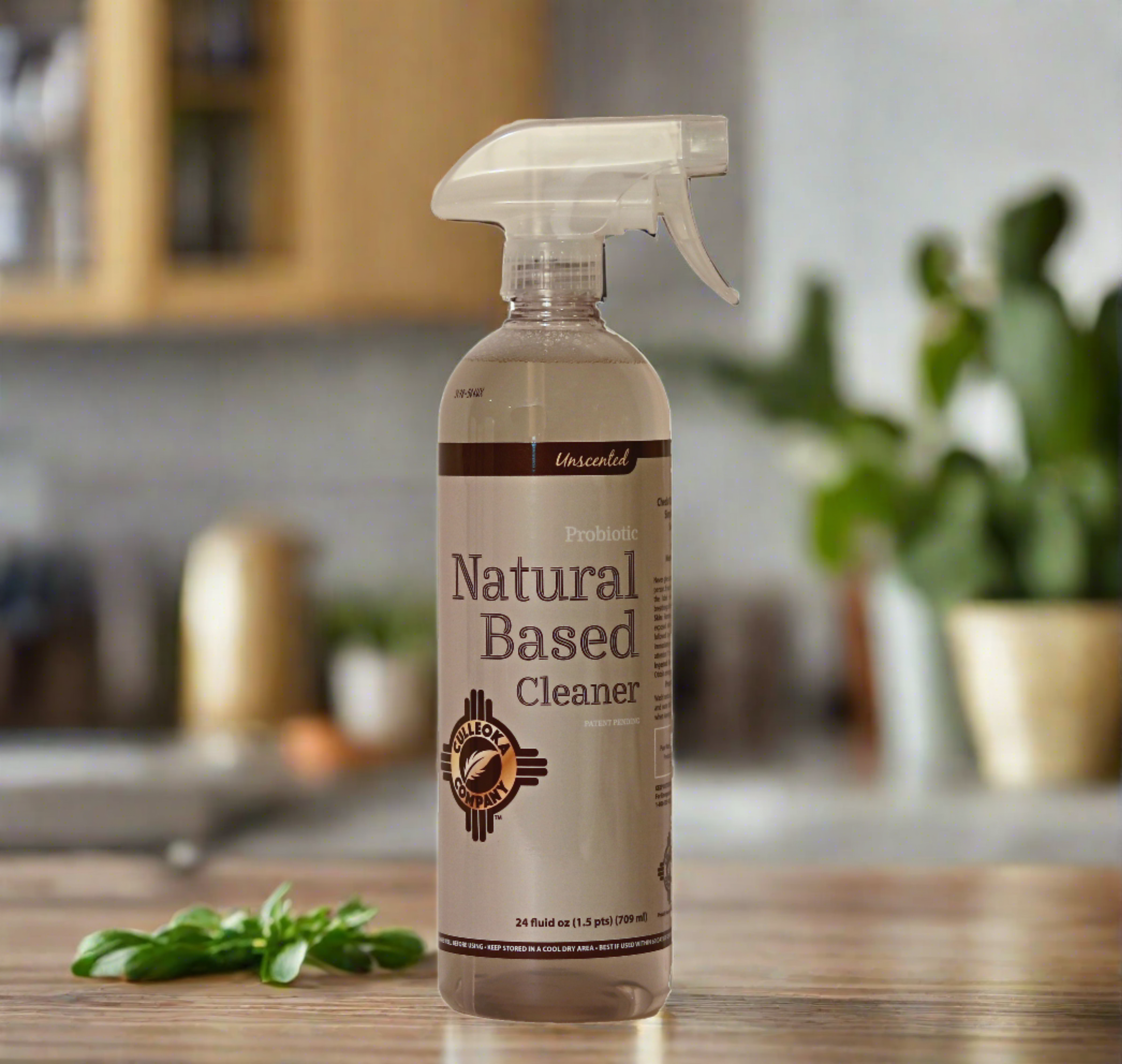
That's part of the thinking behind our Natural Based Cleaner.
The formula combines naturally derived cleaning ingredients with seven strains of non-pathogenic, enzyme-producing bacteria designed to help tackle everyday soils and organic buildup.
It gives you a practical everyday cleaner while incorporating biological cleaning technology.
And that idea fits into a much larger philosophy at Culleoka:
Less Toxins. More Life.
Creating healthier spaces isn't about making one dramatic change.
It's about becoming more thoughtful about the products we bring into the places where our families live, children learn and people work.
[Explore Culleoka's Natural Based Cleaner →]
Frequently Asked Questions About Probiotic Cleaning
What is a probiotic cleaner?
A probiotic cleaner is a cleaning product containing selected beneficial microorganisms. Depending on the formulation, these microorganisms can produce enzymes that help break down organic material as part of the cleaning process.
What are probiotic cleaning products?
Probiotic cleaning products combine cleaning ingredients with selected microorganisms. They are designed to clean surfaces while incorporating biological processes such as enzymatic breakdown of organic material.
What is probiotic technology?
Probiotic technology involves using selected beneficial microorganisms for a particular purpose. In cleaning applications, microorganisms may be selected for characteristics such as their ability to produce enzymes that break down proteins, fats, carbohydrates and other organic material.
Are probiotic cleaners disinfectants?
Not automatically.
Cleaning and disinfecting are different processes. A product making disinfectant claims must meet applicable regulatory requirements and be used according to its registered label. A probiotic cleaner should therefore not be assumed to disinfect simply because it contains microorganisms.
Do probiotic cleaners contain bacteria?
Yes. Products described as probiotic cleaners contain selected microorganisms as part of their formulation. The specific strains and concentrations depend upon the manufacturer and product.
Do probiotic cleaners work differently from regular cleaners?
They can. Conventional cleaners primarily rely on cleaning ingredients and physical action. Probiotic formulations add microorganisms and associated enzymatic activity to the cleaning process.
Can probiotic cleaners help with organic buildup?
That is one of their primary areas of interest. Enzymes produced by microorganisms can help break down components of organic material such as proteins, fats and carbohydrates.
Are probiotic cleaners the same as enzyme cleaners?
Not necessarily.
An enzyme cleaner contains enzymes directly in its formulation. A probiotic cleaner contains microorganisms capable of biological activity, which may include producing enzymes.
The technologies can overlap, but they aren't necessarily the same thing.
A Different Way to Think About Cleaning
The science of the microbial world has changed dramatically over the past several decades.
We're learning that the environments around us are not sterile spaces. They are complex ecosystems where microorganisms, people, animals, surfaces and the products we use continually interact.
Probiotic cleaning is one example of how that understanding is beginning to influence the products we use.
Instead of asking only:
“How do we clean this surface?”
We can also begin asking:
“How can biology help us clean differently?”
For Culleoka, that fits naturally with our mission of helping families and organizations make more thoughtful choices for the places where they live, learn, work and gather.
Less Toxins. More Life.

Written by Sonny Hobbs



Leave a comment
This site is protected by hCaptcha and the hCaptcha Privacy Policy and Terms of Service apply.